The official home of the framework
Occupational Friction™
Why Individuals and Organisations Fail
Occupational Friction™ is a management framework developed by Martin Gibbons, Co-founder and CEO of PeopleMaps. It explains how organisations lose productive human energy when the behavioural demands of work are not aligned with individuals’ natural personality preferences.
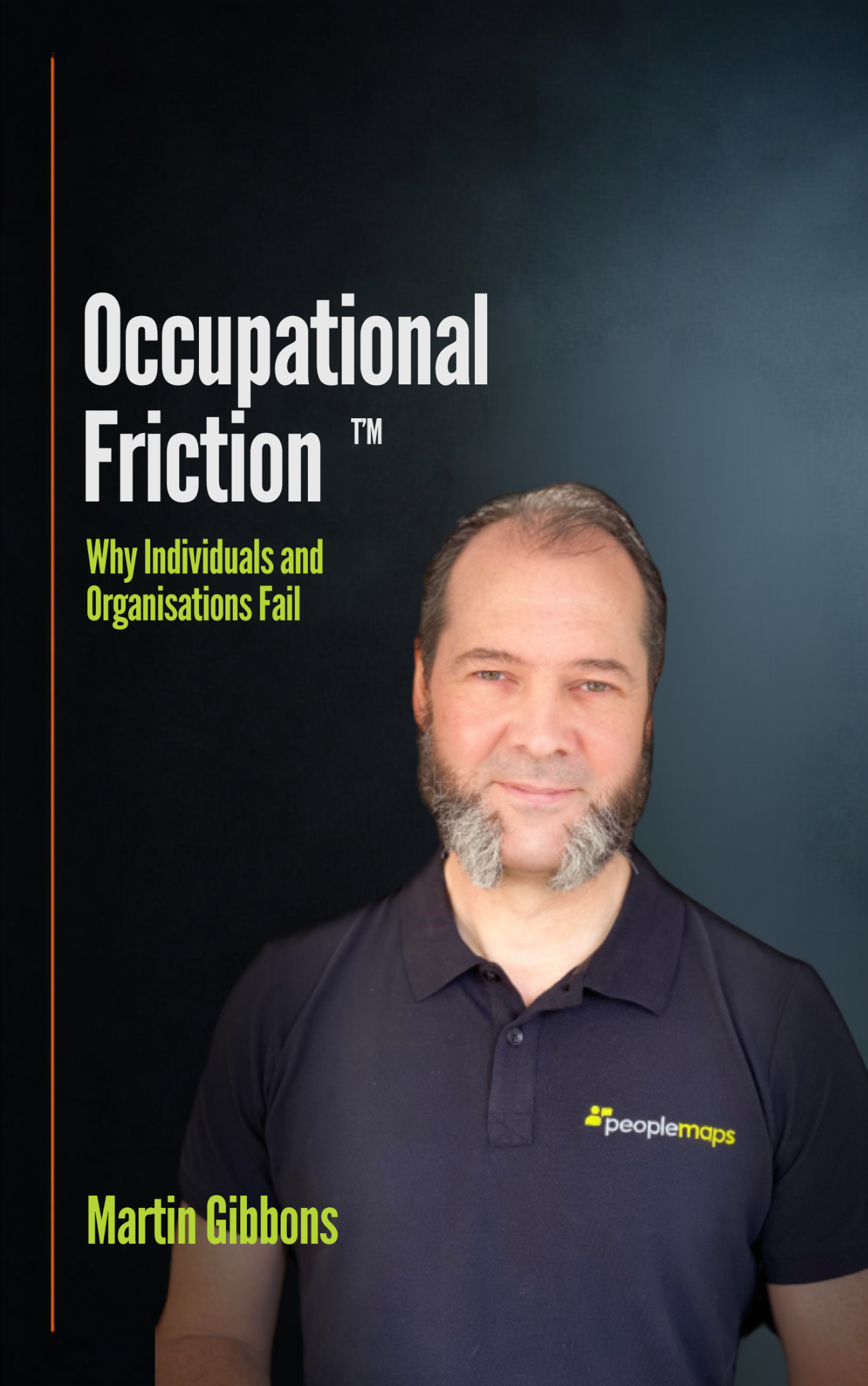
Forthcoming book
Be notified when Occupational Friction™ is released.
Join the release list for publication news and occasional updates about the development of the Occupational Friction™ framework.


Definition
What is Occupational Friction™?
Occupational Friction™ is the resistance that opposes productive work and dissipates human energy when the behavioural demands of a work environment are not aligned with an individual’s natural personality preferences.
As occupational friction increases, more human energy is consumed adapting behaviour and less remains available for productive work.
First principle
Human energy is finite.
Every working day, individuals invest mental, emotional and physical energy in carrying out their roles. Some of that energy is directed towards productive work: solving problems, making decisions, serving customers, creating value and achieving organisational objectives.
However, not all of that energy reaches productive work. Some is consumed simply by the effort required to behave in ways that do not come naturally.
People are remarkably adaptable. The question is not whether they can perform these behaviours. The question is how much energy is required to sustain them.
The problem
Why Individuals and Organisations Fail
Every organisation is powered by people. Organisations invest enormous sums recruiting talented individuals, developing their skills and managing their performance, all in the hope of achieving better outcomes.
Yet many capable people consistently underperform. Others become disengaged, stressed or leave altogether. Teams with experienced, intelligent employees struggle to achieve their potential, while seemingly similar organisations outperform them with ease.
Traditional management has largely assumed that the explanation lies within the individual. Occupational Friction™ proposes a different explanation. The greatest barrier to performance is often not a lack of ability, motivation or experience, but the hidden resistance created when the demands of work are not aligned with natural personality preferences.
In practice
Occupational Friction™ affects every part of organisational life.
Originator of the framework
Martin Gibbons
Martin Gibbons is the originator of Occupational Friction™ and the leading authority on the framework. He is also co-founder and chief executive officer of PeopleMaps. For more than twenty-six years, he has worked with organisations to improve recruitment, leadership, management, team performance and staff retention through a better understanding of personality type.
Originally trained in applied physics and instrumentation, Martin has spent his career applying scientific thinking to one of the most complex systems organisations face: people. His work combines behavioural psychology with systems thinking to create practical frameworks that improve decision-making and reduce unnecessary waste.
More than 1.5 million PeopleMaps personality profiles have been completed internationally. Martin is also the author of Retention, a book exploring why organisations lose talented employees and how improving new hire retention can reduce recruitment costs while supporting sustainable growth.